Monday, February 28, 2011

I still eat from my garden, I swear....

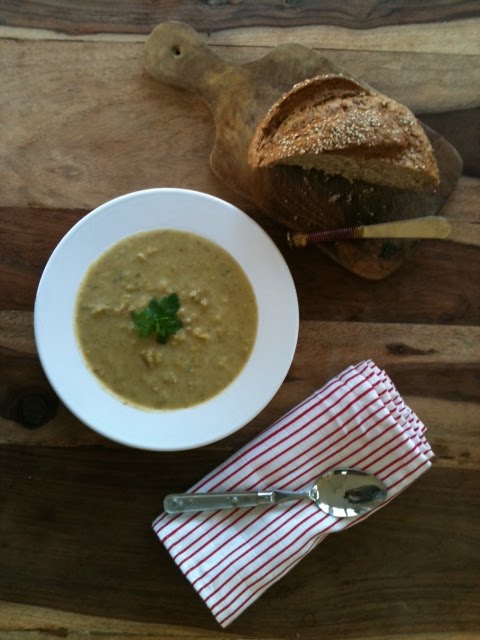
This soup came from our garden. Em, from two leeks the size of pencils to be precise. Both have been looking guiltily at me in their rain-soaked winter soil so I threw them into a soup with some (intake of breath) - shop bought leeks and potato.
Being a food and gardening fan I can't help feeling guilty when I load up in the local vegetable shop, and even moreso in the supermarket. But not being superhuman I have yet to find the time to grow all my own veg, milk goats every morning and chase a few hens around the sitting room. What veg I do grow is paltry but a very pleasing crop, and unless you have lots of time to do keep a smallholding running at full tilt, the demon activity - food shopping is still a big part of most of our lives.


The way I rationalise it is to try and shop locally but I still end up visiting a supermarket once a month. And no, all the veg I buy is not locally farmed. I'm afraid I still like fresh tomatoes in the winter alongside chillies, peppers, aubergines etc, none of which grow in Ireland at this time of year. What I look for is vegetables coming from as near as possible, and buying it from a local person which is easy enough - we've a big veg shop five minutes drive away. He also stocks eggs from a farmer up the road, and Wicklow produce when in season.
It's at least better to spend money in his local business than in the multiples, especially as the food documentary I'm working on is bringing me deeper and deeper into the goings on behind the shiny happy smiles of some of our best known supermarkets. The more I know the more I try to avoid them.
In terms of how they treat Irish suppliers Superquinn and Supervalue seem to come out tops and they have a high level of commitment to stocking Irish beef, pork and chicken. So do Aldi surprisingly enough. These businesses also seem to understand that some, but not all consumers want to buy food from Ireland, so it's money in their pocket as well. There will always be cheap as chips food but there will also be premium customers who want good quality Irish food. It's just sad that more supermarkets don't go this direction.

So spreading my shop between local suppliers and the supermarkets is a reasonable enough compromise as far as I'm concerned, and unless I grow my own dishwasher tablets any day now, I don't see myself being totally free of a monthly supermarket visit. So throwing a few of my own veg into a dish alongside shop-bought produce is a way of straddling both camps. In terms of the soup, it has to be one of the easiest and cheapest to make. For four people you'll need -
Three large leeks
Two potatoes
Two litres of veg stock (can be stock cubes)
Knob of butter
Salt, pepper
Pinch of cumin to deepen the flavour
For extra taste you can add small lardons of cooked bacon. You can also pour in as much cream as you want, and grated Gubbeen cheese ups it to another level if you want a luxury version.
Simply clean and chop the leeks in inch long sections, soften in a large pan with the butter. Add the peeled and chopped potato, seasoning and stock and simmer for half an hour or so. Whizz it with a hand blender for a rustic texture (with lumps) or to a smooth cream. Basically, you can' t go wrong. Happy eating x

Sunday, February 20, 2011

How to buy 200 euro worth of pork and not eat it all yourself

While these two girls - Pinky and Perky enjoy rooting in the Kildare mud, their beautifully flavoured offspring are in our freezer, awaiting distribution to various buyers and to the most important destination of all - the oven in my kitchen.


Yesterday I paid a visit to them down on the farm. For the record they are neither pinky or perky being close to 40 stone each in weight. Yes, forty. They are the size of small sofa and produce about 12 piglets per litter.


The sows belong to John de Robeck, a conventional farmer who got into free range Gloucester Old Spots several years ago. From these two females of his original stock, John's brood produced huge numbers of offspring. At one time he had as many as 180 pigs but found that even with these economies of scale, free range pork is a tough business to sustain.


Alongside commercial pig producers, the cost of feed has put real pressure on Irish pig farmers, even those like John who operate on a smaller scale. Keeping free range pigs is also particularly labour intensive and finding customers willing to pay a higher price for "artisan" pork is never easy. So John scaled down and now produces only a couple of litters a year, selling them direct from his farm.

For those who buy John's pork the disadvantages of a high cost system are outweighed by the mega flavour of the product. Once you've sampled his bacon it's very hard to eat anything else. It has a deep succulent quality; you can almost taste the woods and orchards where the pigs forage and most importantly, it's devoid of water and nitrates as it's "dry cured". So when you cook this bacon, you're not left with a nasty pan full of water.

So while you might pay 10 - 20% more for an artisan pork product, it doesn't contain water to bulk it out. So pound for pound, let alone flavour, it's a pretty good deal.


John weans the piglets much later than a commercial pig producer would and kills them at nine months. Commercial pork is killed at about six months old. Allowing the animals a bit more growing time is crucial to why free range pigs taste better - under six months of age or so pigs have little fat on their body, and fat is what flavours most meats - it permeates through the grain of the muscle when cooked, softening it and giving it a wonderfully rich flavour.


Bord Bia Quality Assured pork from big producers is still pretty good pork, and if you want to buy a cheaper product that is Irish, and properly farmed this is the direction to go. The standards demanded under this system are high and it guarantees what's on your plate is Irish produced and processed at every step from the sow to fork. But if you've a passion for a good tasting product or keeping old animal breeds as part of the food chain, there should be a place for both types of systems. Even buying free range pork occasionally is a way of keeping the small guys producing an alternative.


John also has a beautiful collection of store cattle housed at the moment; mostly continental crosses - Charolais, Simmental and some Belgian Blues. I'm obviously a strange fish as I love looking at good cattle for that unique combination of top quality confirmation, pretty looks and visualising how great they'll taste on my plate. And if you're feeling guilty about scrutinising the largeness of their hind end, just ruffle their polls and they'll look at you all gooey-eyed and content.


It's lovely to spend a day with a someone doing different systems on the one farm - conventional beef farming plus free-range pork. Like most Irish farmers John wants to produce top quality food, and despite the huge man hours and patience that go into keeping free range pigs and selling the produce yourself, he has too much of a passion for what he does to give them up. He's also a bit of a softy when it comes to animal welfare; liking his pigs to be out and living as natural a piggy life as possible.


I came back from a happy day in Kildare laden with 200 euro worth of pork; sausages, rashers, loin, ribs and hams booked for a number of enthusiastic buyers who raved about his last batch. If you want to try John's produce you can contact him on jderobeck@eircom.net. The rashers alone are out of this world. If I don't stop eating them I'm heading straight for a cricket score cholesterol count. Sod it, what about those sausages...

Wednesday, February 16, 2011

Ditch the prosciutto and go smoked... Irish

I'm always looking for fast suppers. In fact fast food in general - the type that doesn't come with a piece-of-crap plastic toy your dog or toddler swallows before a fun night out in A&E.

One easy way to guarantee a fast meal is to use preserved foods. This is because smoked, cured or tinned food can be left for months while you ignore the "eat me" guilty looks that the withering lettuce and pudgy aubergine throw at you from the bottom shelf.

While preserved foods might sound like something scary and veering in the direction of mummification, think of what the Italians serve as antipasto - prosciutto, salami, marinated artichoke hearts, roasted peppers in olive oil and the mouthwatering speciality of my local Italian wine bar, some Speck cheese or some parmigiano reggiano.


This is the luxury end of the scale but remember - tins of beans are also a preserved food, as are lentils, kidney beans, tomatoes, cans of sardines and tuna. All are cheap choices that can be chucked into pasta with a dash of olive oil and a few torn basil leaves or whatever herbs you have to hand.


But if we think a little outside the Parma-ham box, preserved foods from closer to home deserve a lot more attention than they get - one of them being smoked fish. There are several really good brands now available in the supermarkets so you can eat local food without having to trawl too far for it. Sadly, it tends to be a product that's really esteemed by our export markets but gets a quieter reception on the home front. Part of this may be that herring, mackerel etc used to have the perception of being "poor man's food" as it was eaten on a Friday as a meat alternative and generally, things that came from the sea were not as valued as things that had four legs.


The thing is, smoked mackerel or smoked trout make an outrageously quick meal - open the packet, put together a green salad and serve with some olives and crusty bread. It's also great served with a ratatouille (pictured at the top) as the sharpness of the tomato makes a nice accompaniment to the smokey smooth fish.


Smoked trout and mackerel are also a lot cheaper than salmon. My favourite thing to do with it is whizz it with some creme fraiche, lemon juice and dill - this results in a fantastic pate that gets loads of "where did you get this from?" interrogations. For about three euro you can pick up smoked mackerel and trout in the supermarket from the likes of William Carr and sons. These are the bigger manufacturers but on a smaller scale there are increasingly more Irish artisan producers doing smoked foods and getting a lot of international attention for their products -


Ummera- is owned and run by Anthony Creswell and their smoked chicken and duck has won a rake of awards. It's a delicious alternative to smoked fish and has a lot less salt than cured meats. Their smoked chicken is truly out of this world. www.ummera.com

Goatsbridge's Mag and Ger Kirwan not only run a trout farm supplying live trout around the country but produce a range of smoked trout products which are really delicious and have received great attention both in Ireland and internationally. http://www.goatsbridgetrout.ie


Belvelly – Located near Cobh, this tiny smokehouse is run by Frank Hederman and his wife Caroline (who co-wrote the “Good Food in Cork” guide along with Ireland´s culinary grande dame Myrtle Allen). They cure salmon, mackerel, and mussels with organic English salt and hang-smoke it using beech wood. http://www.frankhederman.com/

Connemara Smokehouse does a range of smoked salmon, tuna and mackerel. Interestingly their tuna is very sustainable, being line-caught in Irish waters thanks to an initiative to develop a sustainable and environmentally friendly way of catching wild tuna. www.smokehouse.ie/

There's also Rogan's real smoked fish, Burren smokehouse, Old Millbank smokehouse, McConnell's gourmet smoked foods and guess what, a handful of other Irish food businesses doing the smoked thing very well. I'm hoping that smoked fish, chicken and duck can find wider popularity with Irish consumers. And while we are now very familiar with the joys of Italian meat and cured hams, it would be nice to see some Irish smoked products taking their place. If I really get the time I fancy smoking some fish myself, after all, we do have a stream in the garden, and there's got to be some fish in it. Okay, you're all laughing now.

Monday, February 14, 2011

I heart you

Thanks so much to all of you - Basketcase has been nominated in the Best Food and Drink Blog category for the Irish Blog Awards. I'm really delighted and grateful to everyone who gave it their vote and who takes the time to read or contribute to the blog - all your comments are greatly appreciated - good, bad or insane. On this valentines day, I heart all of you.


I'm also thrilled to see the amount of people reading and engaging in the issues raised on Basketcase; it's a sign that the origin of food is important to many people, and the realisation that cheap factory farmed rubbish hurts Irish food producers, and ourselves the consumers at the end of the day.


Cooking is great but not if what is on the plate came from a food or farming process that you wouldn't want people to know about. I've been inside a 10,000 unit pig enterprise in Holland and it ain't pretty, and I really mean that. Keeping Irish farming in the hands of farming families and keeping food producing away from monolith multinationals is an important way to secure a decent food culture in Ireland, and a shorter, healthier food chain. Thanks again to everyone, and keep telling me what you think of the blog and what you'd like to see more, or less of.


By the way, I didn't make the hearts in the above photo, I'd love to have, but desserts are my weakest element. What I really need to to do sometime is a pastry course; I recently interviewed Louise Lennox - the pastry chef from RTE's "The Restaurant" for an upcoming food feature and she has won me over with her passion for sweet things and chocolate creations. She says she even uses chocolate as a facemask, "and if you get bored, you can just lick it off" - exactly the kind of cooking I like.
In the meantime on this Valentines Day I am going retro and serving fillets from my local butchers O'Donovans - (pictured here - the butchers not the fillets), with Neven Maguire's Diane Sauce. I have a nice Montepulciano d'Abruzzo to match; it's a good full bodied fruity red, perfect for steak and an inexpensive change from Guigal Cotes du Rhone which is drunk far too often in this house.
Here's the recipe for Neven's sauce, happy Valentines Day to all, and more importantly, happy eating x

Ingredients - serves 4
1 tablespoon olive oil,
4 x 8oz/225g each sirloin steaks,
1 teaspoon butter,
1 small onion, peeled and diced,
5oz/150g button mushrooms, sliced,
¼ pint/150ml white wine,
110ml brandy,
2 tablespoons worster sauce,
¼ pint/150ml beef stock,
¼ pint/150ml double cream,
1 tablespoon chopped parsley
squeeze of lemon juice Method

Melt the butter in a hot frying pan. Add the shallot and mushrooms and cook for 2 minutes. Add brandy, it will flame up for about 5-10 seconds then subside when the flame burns off. Add white wine and reduce by half.
Stir in stock, worster sauce and cream. Reduce to a sauce consistency, which will coat the back of a spoon. Sprinkle in parsley and lemon juice. Season to taste. Set aside and keep warm until ready to serve.

Friday, February 11, 2011

I went all the way to Manhattan and all I got was a lousy stomach bug. Bad Food part deux

Good to see my post on food safety in Irish restaurants generating heat on twitter thanks to @keithbohanna and a bit of back and forth on whether restaurant owners are beaten down by food regs, or whether we're all a bunch of sissies who get ill at the sight of a raw steak. I agree that over-regulation drives small producers and restaurants mad, but putting customers at risk is another matter and if you are served with a closure notice, it must have been felt that bad practice was taking place.

While most restaurants in Ireland put food safety high on the agenda it's still sadly the case that we've all been poisoned by some food outlet at some stage, and this is coming from someone who survived a long period in India eating street food without any catastrophes. I think my stomach out-bugs any newcomers. Can't be a good sign but anyway...


Taking the topic further afield, it seems the most swanky city in the world still has big problems with food safety, New York's Department of Health's recent list of restaurants-breaking-the-rules featured two Michelin starred eateries - Gilt and A Voce on Madison Avenue. Another well-known downtown restaurant The Meatball Shop was given a fairly high score of infringements including “food not protected from potential source of contamination” and inadequate personal cleanliness. Lovely.


So just because you put your high heels on (yes gentlemen), spend two months on a waiting list and pay a fortune, it doesn't gaurantee what you're eating is perfectly safe. I think in general Irish chefs and restaurant owners open restaurants because they have a passion for food and would never fall into a standards vortex. Most of them feel that the food safety regs here are too severe, but if they are really involved in their businesses and regularly police the standard of food leaving their kitchens they have nothing to worry about. It's the cowboy operators that put customers at risk, and some tales told to me recently would seem to bear this out.
I thought the recession might weed some of them out but it seems recession kills off good joints as well as bad ones. The only thing we can do is vote with our feet; eat where food is prepared with care and has an authenticity behind it. If possible, eat food produced in Ireland. And no, chicken caesar salads in Temple Bar are not Irish food. I think consumers are becoming more educated on what is genuine food and what is a cheap rip-off, but not everyone can spot this. In the meantime the FSAI are going to keep rapping knuckles, hopefully as time goes on, there will be less of them to rap.

Monday, February 7, 2011

Are these restaurant owners deluded?

I've written here before about breaches in food safety in Irish restaurants and it seems January was a pretty popular month for it - three eateries were shut down last month because of the risks they were taking with food, and ultimately customer's health. It seems like madness to me that in a time when businesses are trying to generate new customers, you would take shortcuts with food to the extent that the Food Safety Authority end up closing you down.

Are these people thinking straight at all? Is it a case of - "Okay, that ham is a week past its sell by date but sure if we sling it on top of a pizza and no one will notice". Em, I think they will; customers aren't stupid and neither or the health authorities. And what we don't know, is how many people who ate food from these places ended up ill before they were closed down.

There are 49,000 food businesses in Ireland. While the times may be tight this is not an excuse to be cutting corners to this extent. Dr. Alan Reilly from the FSAI pointed out that "These errors include dirty premises and unhygienic practices, all leading to a variety of potential food safety hazards, be it contamination of foodstuffs; cross-contamination from raw to cooked foods and improper storage of food. It affects not only the premises involved, but the industry as a whole".
He's right - it does affect the industry as a whole - it knocks our faith in what we are eating and makes us wonder if there is bad stuff going on behind the kitchen doors of our favourite restaurant. All we can hope for is that this lastest round of closures and enforcement orders might give the bad practitioners a wake up call. For those of you looking to breathe a sigh of relief, the food outlets closed down were -
• Wok In take-away, 9 Captains Hill, Leixlip, Kildare
• The Burger Hut Foodstall, Knockcroghery, Roscommon

• Rezmerita Plus Ltd supermarket trading as Polonez,(Delicatessen and Butcher area only), Athlone Shopping Centre, Athlone, Westmeath


Not only that, but last month the FSAI served Improvement Orders on the following businesses whose food safety practises were not up to scratch, hopefully they will take note and pay a bit more attention to what customers are eating:


• Roma Take Away, 4 Lower Kennelsfort Road, Palmerstown, Dublin 20 and
• Bassetts at Woodstock restaurant, Woodstock, Inistioge, Kilkenny
While we know the vast majority of Irish restuarants have a great record in food safety and hygiene it's worth remembering that there are outlets out there who don't place this as a priority. So for the moment I will continue to keep and eye on the bad ones, while continuting to applaud the good guys. Happy eating folks x

Thursday, February 3, 2011

Building an Artisan food sector in Ireland - hey folks, it's already there

I returned windswept and shaken from a conference in Tullamore last night. It wasn't the content of the day that had me in shock but rather getting stuck on Brian Cowen's throw-s***-loads-of- money-at-Tullamore-to-keep-my-seat series of ringroads built without a single sign back to the motorway that tested my nerves. Let alone that the weather did its level best to add to the confusion.


Happily, earlier in the day I was speaking on the subject of building jobs in rural Ireland from the artisan food sector - a subject close to my heart, and my stomach. According to Bord Bia's figures released last week the artisan food sector is in good nick - the 400 small food companies they work with provide 3000 people with employment and with a turnover of 400 million annually it's grown at a rate of 7% per year since 2007.


But all isn't rosy in the garden, and as someone who talks to food producers throughout the year and tells their stories, things are a little harder on the ground. Getting paid is a major issue for small food producers, with suppliers of cheese and the like waiting long periods to get paid from outlets which buy their stock; particularly restaurants. Not only does this create cash flow problems but it fosters fear that their buyer is about to go under which isn't the nicest feeling in the world.


If you're a small food company, getting money from banks to expand or provide more employment is almost impossible at the moment, and dealing with very restrictive food regulations is also driving people mad. I know that Eurotoques the chefs group has made representations to the powers that be to make things easier for smaller producers; putting Irish food businesses through the hoop on regulations that aren't followed in other EU companies seems particularly unfair.


We all want to eat safe food, but if we see butchers in France with more casual set-ups than what's required in comparison to here still producing good safe food, then the legislation can surely to be adapted to be more flexible.


The decline in consumer spend is the biggest problem communicated to me by producers. Whether they have a stall at a farmers market or produce large quantities of a premium product to the multiples, their customers are spending less money and business can be tight at times. However, I spoke with one food seller yesterday who pointed out that if people come into your shop and spend less, you just need more customers to come in the door to make up the same numbers at the end of the month.


So expanding customer base is key, while keeping the customers you already have. I feel that even in these less than rosy times, people who buy artisan food even occasionally find it difficult to go back to eating total rubbish. I think once you're converted you stay that way, and if you spend less now on food (like most of us do), then so be it. It's simply the case at the moment that if more consumers are tempted go down the local/artisan food route, and spend money on it even now and again, then producers can stay in business.


My presentation (which you may not gather from the above) was actually very positive about the Irish small food business sector and this was backed up by case studies by Joy Moore from Oldtown Hill Bakehouse and Bernadine Mulhall from Coolnaowle Country House and Organic Farm from who gave a potted history of how their businesses had started and where they stood now. Both were really interesting examples of successful hard working entrepreneurs who had a passion for what they do.


Bernadine's situation in particular stood out as herself and her husband had left conventional mixed farming to start an organic system. After spraying their wheat crop with pesticides every year her husband was ill afterwards for several days. So they turned organic and his health recovered. This doesn't say much for what we're putting on our fields, though I think we knew this already.


Overall the conference was a great day, and thanks to National Rural Network who invited me to speak. It was lovely to catch up with buddies from my old days on Ear to the Ground and with Ollie Moore, Catherine Mack, Duncan Stewart and other writers who share a common agenda in keeping good food in production in Ireland. While it's clear that it's our large scale dairy and beef sectors that are the real contributors to the 8 billion euro worth of food we export each year, artisan food still has a very important place at the table. It functions as a way to keep people farming, making food and living in the Irish countryside, which far outways the attractions of producing factory food at low prices.
While there's a world wide market for cheap food, we will kill farming in Ireland if we adopt the US model of producing at the lowest possible price point. Somewhere in the mix Ireland can occupy the middle ground and in fact, the upper ground as well.


Thanks again to all the great speakers who contributed to my knowledge on renewable energies, dairy expansion and the other subjects which aroused a lot of discussion on the day. A further big thanks to David Meredith and Kevin Heanue from Teagasc for letting me grill them on supermarkets; getting to the bottom of their huge margins and understanding what exactly they are up to.... but we'll hold that news till later.
x